PEA vs. Other Florida Flight Schools: What Makes Phoenix East Aviation Different?
Looking for the best flight school in Florida? Although there is no shortage of options, not all schools are created equal. At Phoenix East Aviation (PEA), we take pride in our longstanding accreditation, decades of operational history, robust airline partnerships, and strong graduate outcomes.
Read on to see what makes PEA one of the top flight schools in Florida, and consider taking the next step by applying to one of our professional programs.
More Than 50 Years of Operational History
In a market saturated with relatively new schools, PEA sets itself apart with a track record that goes back more than 50 years. Over the decades, we’ve prepared thousands of aviators who have gone on to pursue fulfilling careers in airlines, cargo, corporate aviation, and beyond.
In our 50+ years of operational history, we’ve also had the chance to carefully refine our curriculum, safety culture, and operational standards to reflect the current demands of the aviation workforce. This is the kind of refinement that comes with time and experience.
Nationally Accredited Since 1995
As you compare Florida flight schools, it’s critical to look for accreditation. Flight school accreditation ensures that a school is following industry best practices and high standards for training curricula, instructor quality, and safety.
At PEA, we’re proud to share that our school has been accredited by the Accrediting Council for Continuing Education & Training (ACCET), and has been for more than 30 years. Schools that are ACCET-accredited demonstrate that they have met rigorous standards for quality beyond FAA requirements. This empowers students to enroll with confidence, unlock federal financial aid eligibility, and protect their investment in flight school.
Due to this accreditation, PEA is also one of just a few flight schools in the United States that is authorized to issue F-1 student visas.
A Fleet Built for Career Pilots
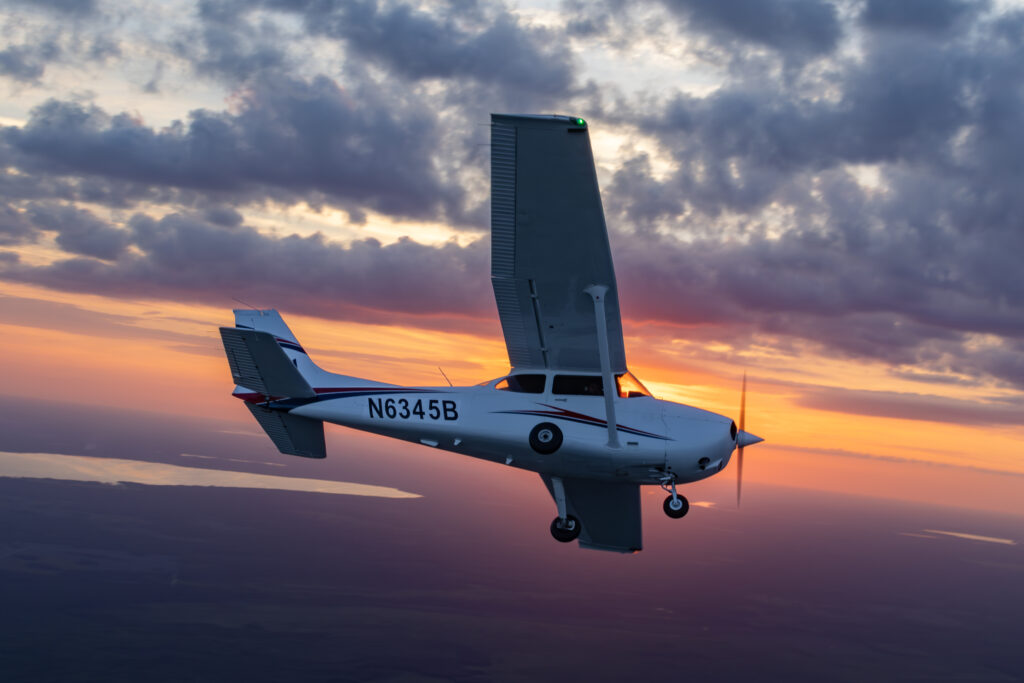
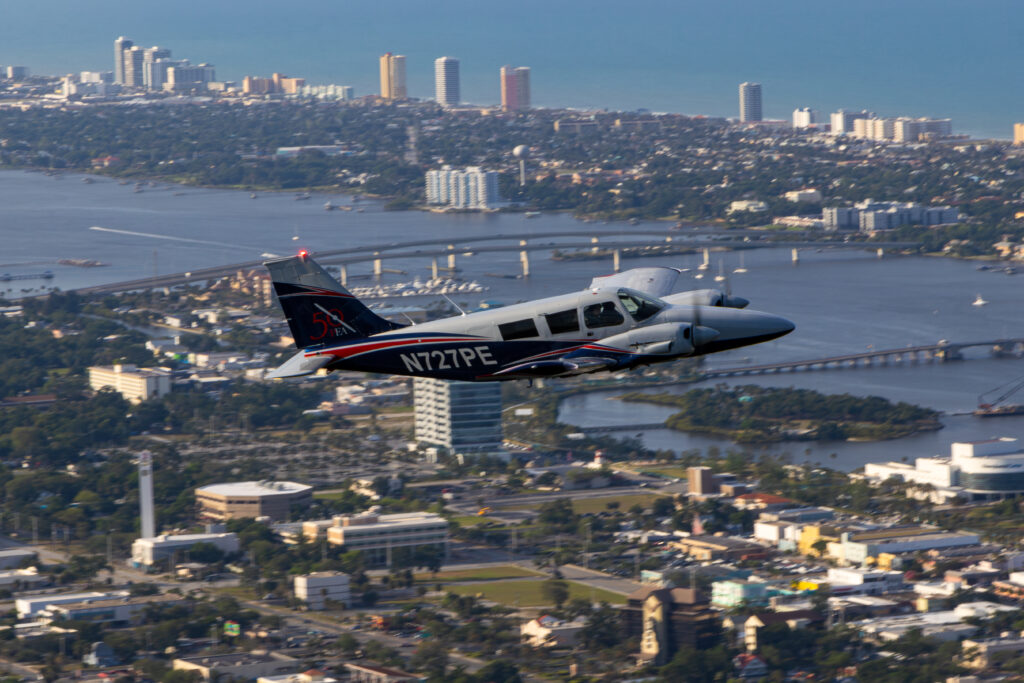
Selecting a school with a robust fleet can help aspiring pilots prepare for the transition to larger aircraft. At PEA, our fleet consists of more than 70 aircraft, including:
- Cessna 172s with Garmin G1000
- Piper Senecas with G500
Our aircraft are equipped with the latest equipment and all-glass cockpits, providing a meaningful career advantage for students transitioning to commercial operations. In addition to our fleet, PEA offers the Redbird FMX Full Motion Simulator and Redbird TD2 tabletop simulators at our Daytona Beach and Flagler Beach campuses.
These simulators provide a unique training experience for students, with the FMX Full Motion Simulator offering wrap-around visuals and a fully enclosed cockpit for a realistic training experience. Through full motion simulation, students build situational awareness, which can accelerate training progression and enhance comprehension.
FAA-Approved Part 141 Training With Structured Progression
PEA is an approved FAA Part 141 and Part 61 flight school with self-examining authority, meaning that the FAA has approved our training syllabus and our school as a whole.
For students seeking a highly structured curriculum with reduced flight hour requirements, Part 141 training often provides a more guided learning experience. With stage checks and regular FAA oversight built into the program, Part 141 may appeal to students who prefer a clearly defined syllabus and a streamlined path toward airline eligibility.
At PEA, our available programs include a 130-hour Professional Program I and a 139-hour Professional Program III:
- Professional Program I – Takes students from Private Pilot Certificate to Instrument, Commercial, Multi-Engine add-on, and Certified Flight Instructor licenses/ratings.
- Professional Program III – Expands into multi-engine training, qualifying graduates to instruct in both single- and multi-engine aircraft.
Location and Flying Weather
Comparing flight schools in Daytona Beach vs. Orlando? Compared to more northern flight schools, PEA’s Daytona Beach location offers the advantage of near year-round flying weather. This, in conjunction with its proximity to Daytona Beach International Airport, affords students the competitive advantage of gaining real-world radio and airspace experience with a controlled, towered airport from day one.
In addition to our Daytona Beach campus, PEA offers numerous satellite locations for your convenience in Fort Lauderdale (at Broward College) and Flagler Executive Airport (accelerated training).
Airline Partnerships and Career Pathways That Actually Deliver
Over the years, PEA’s flight school reputation has been built around career pathways that deliver real results. As part of our flight training programs, students have access to unique opportunities, including participation in the Aviate program through United Airlines. After earning your commercial pilot license with instrument training, you can apply to Aviate and enjoy a conditional job offer (CJO), dedicated coaching from a United Airlines pilot, travel privileges, and more.
Along with PEA’s partnership with United Airlines, students have access to monthly on-campus airline events, including regional carriers, national carriers, cargo carriers, and private jet operators. PEA campuses also host regular open recruiter forums and resume workshops in partnership with JSFirm, helping prepare students as they transition to the job market.
Interested in pursuing a formal degree alongside your flight training? PEA maintains academic affiliations with a wide range of reputable colleges and universities that offer the flexibility of online coursework, including:
- Purdue Global
- Liberty University
- Utah Valley University
- Broward College
International Training Capabilities Few Schools Can Match
PEA offers a number of unique training opportunities for international students looking to attend flight school. For starters, our ACCET accreditation allows us to issue F-1 student visa authorization, making it possible for international students to stay not only for the duration of their training program but also for the additional time needed to obtain documented flight hours.
For prospective students interested in obtaining both their FAA and EASA pilot licenses (permitting flight in both the United States and Europe), our partnership with South Sweden Flight Academy allows students to split their training between these two locations and become airline-ready in no time.
In 2020, PEA also joined a partnership with TNC Aviation to offer a streamlined pathway for Indian students looking to obtain their FAA pilot licenses in the United States and convert them into Directorate General of Civil Aviation (DGCA) licenses, which are required to fly in India. PEA also partners with SAC Pilot Management in South Korea, helping aspiring pilots navigate the transition to U.S.-based flight training through admissions guidance, visa support, and aviation preparation resources.
Finally, for international students looking to enhance their English language proficiency before studying in the United States, PEA has partnered with the University of Central Florida (UCF) Global to provide an Online English Program. In this flexible program, students work at their own pace while enhancing their mastery of English listening, speaking, pronunciation, reading, writing, and grammar.
Find Your Ideal Program at PEA
Deciding on a flight school might feel overwhelming, but it doesn’t have to be. As you compare Florida flight schools, we encourage you to check out a Phoenix East Aviation review (or several!) for yourself. In doing so, you may find that choosing the best flight school in Florida isn’t so difficult.
From our accreditation and expansive fleet to our cutting-edge technology and robust industry partnerships, PEA has designated itself as a school for pilots who are serious about a professional career in flight. Get in touch today to request more information about any of our professional programs or get started with your application for admission now.
Sources
https://pea.com/about-us/choosing-a-flight-school/
https://pea.com/courses/professional-programs/
https://pea.com/courses/professional-programs/professional-program-iii/
https://pea.com/courses/professional-programs/professional-program-i/
https://pea.com/about-us/affiliates-academics/ucf/
https://pea.com/career-pathways/
https://pea.com/admissions/u-s-students/#admission-form
https://pea.com/about-us/affiliates-academics/tnc-aviation/
https://pea.com/blog/pea-partners-with-south-sweden-flight-academy/