How Much Does Flight School Cost? A Complete Breakdown
When researching the path to becoming a commercial pilot, prospective aviators often discover that the estimates for flight school vary widely, from tens of thousands to well over six figures. The lack of clarity about this gap can make it difficult to plan, compare programs, or trust what you’re seeing.
In this article, we aim to answer the question: “How much does flight school cost?” We’ll cut through the noise with a transparent, stage-by-stage breakdown of what it costs to go from zero hours to a commercial pilot certificate. We’ll detail flight school tuition, aircraft rental, testing fees, and living expenses, all while explaining how the program structure with Phoenix East Aviation (PEA) reduces unnecessary repetition and cost.
What Drives the Cost of Flight Training?
There are four main variables that influence flight training costs:
- Aircraft and fuel typically comprise the largest share, with hourly rates adding up quickly.
- Instructor time is another major factor, especially when lessons are repeated or extended.
- Program structure is less obvious but equally important; inefficient sequencing or gaps between lessons can drive up total hours and cost.
- Training pace, when consistent, can reduce the risk of skill loss and rework.
Choosing an efficient path with year-round flying conditions (like those found in Florida) can provide a financial advantage by streamlining the schooling process.
The Stage-by-Stage Cost Breakdown
Flight training isn’t a single expense; rather, it’s a progression of certifications, each building on the last. Understanding how costs accumulate from the Private Pilot Certificate through instructor ratings is key to seeing the full financial picture and identifying where efficiency matters most.
Private Pilot Certificate
The Private Pilot Certificate is the first step in any pilot’s journey, allowing you to fly for personal use, carry passengers, and operate under visual flight rules. The Federal Aviation Administration (FAA) sets minimums at 35 hours under Part 141 and 40 hours under Part 61, though most students log 55 to 70 hours in practice.
This gap is where cost can vary significantly, depending on training efficiency. PEA structures its PPL program to minimize excess hours, offering a fixed, transparent price of $17,786 that reflects a streamlined, proficiency-based approach.
Instrument Rating (IR)
An FAA Instrument Rating authorizes pilots to fly in clouds and low-visibility conditions using instruments alone, making it essential for safety and a requirement for nearly all professional aviation careers. The FAA requires a minimum of 40 hours of instrument time, though actual totals often exceed that depending on consistency and program design.
Nationally, a standalone IR typically costs between $10,000 and $18,000. However, PEA bundles the IR into its Professional Programs, reducing duplication and improving training continuity. This can help lower the total cost of flight school.
Commercial Pilot Certificate
The Commercial Pilot Certificate is what allows you to be compensated for flying, turning aviation from a passion into a profession. The FAA requires a minimum of 250 total flight hours, meaning students must acquire significant experience beyond earlier certifications.
Nationally, earning a Commercial Pilot Certificate can add $25,000 to $45,000 on top of PPL and IR costs, especially when training is fragmented. Expenses such as multi-engine add-ons can further increase that total if not bundled. Structured programs that integrate hour-building and advanced training (such as PEA’s) can reduce redundancy and help control costs that would otherwise begin to compound.
Certified Flight Instructor (CFI), Certified Flight Instructor Instrument (CFII), and Multi-Engine Instructor (MEI)
Instructor ratings are the final stage for many aspiring airline pilots, providing a practical pathway to reaching the 1,500-hour requirement for airline eligibility.
- A CFI authorizes you to teach student pilots.
- A CFII allows you to instruct instrument students.
- An MEI enables training in multi-engine aircraft.
These certifications don’t just add qualifications; they change the financial equation. Instructing provides income while building flight hours, helping offset training costs and making the transition to a professional aviation career more financially sustainable.
What Does the Full Path Cost at PEA? Real Program Pricing
Rather than piecing together ratings individually (which often leads to duplicated training, inconsistent pacing, and higher total hours), PEA offers bundled professional programs designed for efficiency and cost control. These professional programs package multiple certifications into a structured sequence, reducing downtime and unnecessary repetition. Both of our options require a PPL as a prerequisite, which can also be completed at PEA before advancing.
Our programs integrate aircraft time, instructor guidance, and simulator use into a single track to provide clearer pricing and a more predictable path from zero hours to career-ready qualifications.
Professional Program I: $68,835
Professional Program I includes:
- Instrument Rating (IR)
- Commercial Pilot Certificate
- Multi-Engine Add-on
- Certified Flight Instructor (CFI)
- Certified Flight Instructor Instrument (CFII)
Training is conducted across a mix of aircraft and devices, including:
- Dual and solo C-172 glass cockpit
- Dual 8KCAB
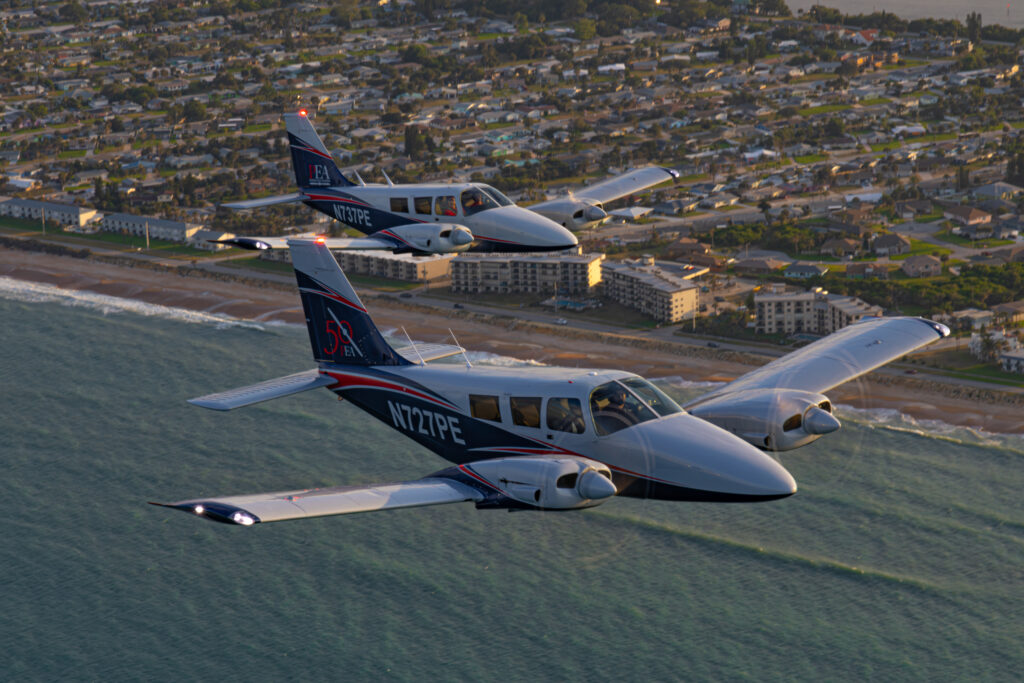
- Dual PA-34
- Redbird simulators
The program includes approximately 130 total flight hours. When combined with the $17,786 PPL, the total cost from zero time comes to about $86,621. This bundled structure reduces redundancy while delivering all core certifications needed to begin instructing and accumulating hours more efficiently.
Professional Program III: $83,805
Professional Program III expands upon Program I by adding more advanced multi-engine training and the Multi-Engine Instructor (MEI) rating. In this program, students earn the:
- Instrument Rating (IR)
- Commercial Single-Engine
- Multi-Engine Commercial
- Certified Flight Instructor (CFI)
- Certified Flight Instructor Instrument (CFII)
- Multi-Engine Instructor (MEI)
This program includes about 139 total flight hours, with significantly more time in the PA-34 multi-engine aircraft compared to Program I. Combined with the initial PPL cost, the total investment from zero time is approximately $101,591.
Both program prices include PA-34 operating costs, which are published on our website to maximize pricing transparency.
Costs Beyond Program Tuition: A Realistic Budget
When estimating flight school costs, prospective students should consider additional expenses beyond tuition. Additional costs include:
- FAA Knowledge Tests – These typically cost about $175 each, and a full training path includes several exams.
- Practical Tests (Checkrides) – These typically run from about $500 to $800 per rating, adding up across certifications.
- FAA Medical Certificate – It’s smart to secure this credential before committing to training. They typically cost about $100 to $200.
- Equipment – Headsets and basic supplies can range from around $500 to $1,500 upfront.
- Housing and Living Expenses – Near PEA in Daytona Beach, the average cost of living ranges from about $900 to $1,400 per month. The consistent flying weather in this area can help reduce delays and overall costs.
Financing Your Flight Training
Many students do not pay for flight training entirely out of pocket. Instead, they rely on specialized aviation lenders (like Sallie Mae and Stratus Financial) that offer loan programs tailored to flight school and pilot training. Schools operating under FAA Part 141 accreditation (like PEA) often expand financing eligibility due to their structured curriculum. Veterans may also qualify for education benefits through the U.S. Department of Veterans Affairs, including GI Bill programs.
In addition, flight school scholarships are available through various aviation organizations. However, they tend to be competitive and usually cover only a portion of total training costs.
Is Flight School Worth the Investment?
At Phoenix East Aviation, the total investment from zero time typically ranges from about $86,000 to $102,000, depending on the program path. That’s a significant commitment, but the earning potential may shift the equation.
Entry-level airline pilots commonly earn between $90,300 and $120,700 annually, outpacing the average bachelor’s degree starting salary of roughly $68,680. According to the U.S. Bureau of Labor Statistics, airline and commercial pilots earned a median salary of $198,100 in 2024.
In the context of ongoing pilot demand (driven by retirements, fleet growth, and global travel needs), the return on investment becomes more compelling. While training costs are front-loaded, the long-term income trajectory and career stability make flight training a financially viable path for many aspiring pilots.
Find the Program That Fits Your Goals
Flight training costs vary widely and can be confusing. However, costs become clearer when broken down step by step, from ratings and flight hours to housing and training pace. At Phoenix East Aviation, structured programs are designed to eliminate guesswork and support efficient progression from day one of flight school. Whether you’re evaluating total investment, timeline, or potential career outcomes, the key is choosing a path that aligns with your goals and budget.
We invite you to explore PEA’s full program details, timelines, and transparent pricing to understand exactly what your journey from zero hours to airline-ready pilot could look like. Ready to take the next step? Contact us directly to get personalized guidance on choosing the right program for you.
Sources
https://www.faa.gov/pilots/become
https://pea.com/courses/professional-programs/private-pilot-license/
https://pea.com/courses/professional-programs/professional-program-i/
https://pea.com/courses/professional-programs/professional-program-iii/
https://pea.com/courses/professional-programs/
https://www.forbes.com/advisor/mortgages/real-estate/cost-of-living-calculator/daytona-beach-fl/
https://www.bankrate.com/loans/student-loans/average-college-graduate-salary/
https://www.bls.gov/ooh/transportation-and-material-moving/airline-and-commercial-pilots.htm