Basics of Flight: The Fundamentals Every Student Pilot Should Know
The basics of flight come down to a handful of ideas every student pilot learns first: the four forces that act on an airplane, the control surfaces that steer it, the three axes it moves around, and the ways speed is measured in the air. Understanding these fundamentals of flight is what turns a set of levers and pedals into an aircraft you can fly with intent. This guide covers each one, along with how the FAA classifies aircraft and how an airplane is built. Basic aeronautical knowledge starts here, and it is the same ground every student covers before their first solo.
Key Takeaways
- Four forces act on an airplane in flight: lift, weight, thrust, and drag. Balanced, the aircraft holds a constant velocity; unbalanced, it accelerates toward the stronger force.
- Three primary control surfaces steer the aircraft. Ailerons roll it, the elevator pitches it, and the rudder yaws it.
- Each control surface moves the aircraft around one of three axes: longitudinal, lateral, and vertical.
- Increasing angle of attack increases lift, but only up to the critical angle. Past it, the wing stalls.
- Airspeed is measured five ways. Indicated airspeed is what the instrument reads; groundspeed is what you actually cover over the ground.
- The FAA classifies aircraft by category, class, and type, and each level narrows what a pilot is certified to fly.
Aircraft Category, Class, and Type
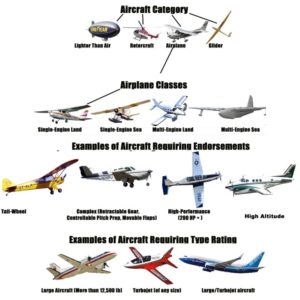 The FAA sorts aircraft three ways: by category, by class, and by type. Each level is narrower than the last, and together they determine what a pilot is certified to fly.
Category
Aircraft categories, established by the Federal Aviation Administration (FAA) and other global aviation organizations, provide a broad classification system that groups aircraft with similar characteristics and intended uses. Take a look at the list below for some specific aircraft categories that may appear within the aviation industry:
- Airplanes;
- Gliders;
- Rotorcraft;
- Balloon.
Each of these are designed for specific operating environments and purposes.
Class
Aircraft classes provide a distinct classification system, and much like their categories, are established by the FAA. Think of an aircraft class as a “subdivision” to the category which was previously discussed. An aircraft class allows for a more precise categorization of aircraft, reflecting their operational capabilities and design features. This system helps aviation authorities make sure pilots are trained and certified for the right classes of aircraft.
Type
For pilots looking to expand their aviation experience and knowledge, understanding aircraft types is crucial. An aircraft type refers to a specific make and model of an aircraft, such as a Boeing 737 or Airbus A320. Each type has its own unique design, configuration, and capabilities.
The Federal Aviation Administration (FAA) uses these type definitions to determine the different qualifications pilots need to operate a particular aircraft safely. It is not just about being able to fly any plane, rather mastering the specifics of each aircraft type. Keep in mind, for an individual aspiring to fly for a commercial airliner, any aircraft weighing over 12,500 pounds, or any turbo-jet powered aircraft (regardless of its weight), requires a “type rating”. This is a specific privilege on an airman’s certificate, and involves rigorous training and demonstrates that a pilot has the necessary skills and knowledge to operate that particular aircraft safely.
The importance of understanding aircraft types and working toward type ratings is an exciting journey for pilots. It’s all part of the continuous learning and skill development that makes the aviation industry such a dynamic and rewarding field.
Airplane Structure
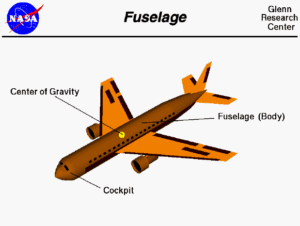
Airplanes come in various shapes and sizes and all share fundamental components that work together to achieve flight. The main structure of an airplane include the fuselage, wings, flight deck, engines, tail (empennage), and landing gear. Each of these elements plays a crucial role in the aircraft’s performance and safety, and understanding how these parts work together is the first step in grasping the principles of aerodynamics.
Fuselage
A Fuselage, or body of the airplane, is a long hollow tube that holds all the components of the aircraft together. It is designed to be hollow in order to reduce weight. As with most other parts of the airplane, the shape of the fuselage is typically determined by the mission of the aircraft.
Wings
The wings of an aircraft play a crucial role, serving a purpose similar to that of a bird’s wing – hence the name. As fixed-wing aircraft, airplanes rely on their wings to generate lift, enabling them to soar through the skies. The design of the wings, combined with the speed of the aircraft, creates the lift necessary for it to take flight.
Flight Deck
The flight deck is where the pilot sits to control the aircraft and includes its flight instruments, avionics, and radio communications, along with flight controls.
Engine
An aircraft’s engine is the main component of an aircraft’s propulsion system, or in other words, what generates thrust to propel the aircraft forward.
Propeller
A propeller is an aerodynamic device that transforms rotational energy into thrust, enabling an airplane to move forward. This thrust is generated perpendicularly to the plane of rotation and is produced by the propeller’s blades, which are evenly spaced around a central axis. Propellers typically feature two or more blades and can be designed with either a fixed pitch or variable pitch configuration, allowing for different performance characteristics.
Tail (Empennage)
The empennage, commonly known as the tail or tail assembly, is situated at the rear of an airplane and plays a crucial role in maintaining stability during flight. It ensures that the aircraft remains steady and well-balanced as it navigates through the skies. The tail consists of several components, including the vertical stabilizer, rudder, elevator, and horizontal stabilizer, all of which work together to enhance the aircraft’s performance and control.
Landing Gear
One of aviation’s most critical components, the landing gear, serves as a versatile system that extends far beyond its legitimate function, landing. The landing gear allows the aircraft to transition smoothly between air and ground. Most planes use regular wheels, but specialized aircraft, such as seaplanes, have innovative alternatives like floats allowing for a water landing. High-performance aircraft, particularly twin engine and jet configurations, have retractable landing gear. This mechanism allows for the wheels to be tucked away after takeoff, reducing aerodynamic drag and allowing the aircraft to achieve optimal flight efficiency.
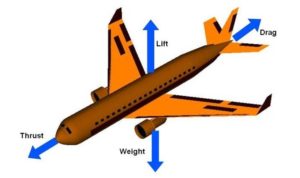
Forces of Flight
Flying relies on four fundamental forces that work against each other in a constant balance: weight, lift, drag, and thrust. Understanding these forces is the foundation that allows pilots to predict and control their aircraft’s behavior, whether they are climbing to a cruising altitude or executing a perfect landing.
Weight
Weight is a force that consistently acts toward the center of the Earth, playing a crucial role in the aerodynamics of flight. The magnitude of this weight depends on several factors such as, but not limited to, the mass of all the airplane components, the fuel onboard, and anything additional such as passengers and baggage, or freight. While the weight is distributed throughout the aircraft, it can often be conceptualized as concentrated at a single point known as the center of gravity. During flight, the aircraft rotates around this center of gravity, influencing its stability and maneuverability.
Lift
To counteract the force of weight, airplanes generate an opposing force known as lift. Lift acts perpendicular to the direction of flight and its magnitude is influenced by several factors, including the wing’s shape, size, and velocity. Similar to weight, each part of the aircraft contributes to the overall lift. Most of this lift is produced by the wings. Lift is concentrated at a single point called the center of pressure, which is defined similarly to the center of gravity, but is based on the pressure distribution around the aircraft rather than its weight distribution.
Drag
As an airplane flies through the sky, it encounters another aerodynamic force known as drag. This resistance force opposes the aircraft’s motion and is directed along the flight path. Several factors influence the magnitude of drag, including the aircraft’s shape, the viscosity (or the property of fluid that causes air to resist flowing), and its speed. Just as with lift, the individual drag forces from various components of the aircraft are combined to determine the overall drag magnitude.
Thrust
To counteract drag, airplanes rely on a propulsion system to generate a force known as thrust. The direction of this thrust force varies based on how the engines are mounted to the aircraft. The magnitude of thrust is influenced by various factors related to the propulsion system, including the type and number of engines as well as the throttle setting. The aircraft’s motion through the air is determined by the relative strength and direction of the forces at play. When these forces are balanced, the aircraft maintains a constant velocity; however, if they are unbalanced, the aircraft will accelerate in the direction of the dominant force.
Primary Flight Controls
The three primary flight controls are the ailerons, elevator, and rudder. As explained in the FAA’s Pilot’s Handbook of Aeronautical Knowledge, together they allow a pilot to control the aircraft around its three axes of motion. Learning how these surfaces respond to cockpit inputs is one of the most important parts of mastering the basics of flying.
Ailerons (Roll)
Ailerons sit near the outer trailing edge of each wing and control the aircraft’s roll. They move in opposite directions: When one aileron rises, the other lowers. The raised aileron reduces lift on its wing, while the lowered aileron increases lift on the opposite wing, causing the aircraft to roll.
The pilot controls the ailerons by turning the yoke or moving the control stick left or right. For example, moving the control to the right raises the right aileron and lowers the left one, causing the aircraft to roll to the right. Pilots use this rolling motion to bank the aircraft when entering or leaving a turn.
Elevator (Pitch)
The elevator sits on the horizontal stabilizer at the tail and controls the aircraft’s pitch. Pulling back on the yoke raises the elevator, which generally lowers the tail and raises the nose. Pushing the yoke forward lowers the elevator, raising the tail and lowering the nose.
Pitch changes influence the aircraft’s angle of attack and help pilots manage climbs, descents, and airspeed. Because pitch and power work together, pilots learn to coordinate elevator inputs with appropriate power adjustments.
Rudder (Yaw)
The rudder sits on the vertical stabilizer at the tail and controls the aircraft’s yaw. Pressing the left or right rudder pedal deflects the rudder in that direction, causing the aircraft’s nose to move left or right.
Pilots use the rudder to help coordinate turns, maintain directional control, and counteract forces that can cause unwanted yaw. The rudder is not typically used by itself to turn an airplane. Instead, it works with the ailerons and elevator to produce smooth, coordinated flight.
Secondary Controls: Flaps and Trim
Secondary flight controls include flaps and trim systems. Flaps are normally located along the inboard trailing edges of the wings and increase both lift and drag when extended, allowing the aircraft to fly safely at slower speeds during takeoff and landing. Trim reduces the control pressure a pilot must maintain to hold a desired attitude, helping prevent fatigue during flight.
“I believe there’s a moment during a student’s first flight that’s hard to put into words. It’s the moment when we, as instructors, say, ‘your airplane,’ and for the first time, the student moves the yoke and actually feels the airplane respond. They roll into a turn, pull back slightly, and suddenly realize, I’m doing this. I’m actually controlling an airplane. It’s usually a mix of excitement, nervousness, joy, and pure amazement! As an instructor, watching that happen for the first time never gets old. You can see the confidence begin to build in real time!”
– Taylor, CFI CFII and MEI
The Three Axes of Flight
An aircraft moves around three imaginary lines called the longitudinal, lateral, and vertical axes. These axes intersect at the aircraft’s center of gravity. Understanding how each axis corresponds to a control surface helps student pilots connect cockpit inputs with the aircraft’s movement, making the fundamentals of flying easier to visualize.
Longitudinal Axis (Roll)
The longitudinal axis runs from the aircraft’s nose to its tail, and movement around it is called roll. The ailerons control this motion by increasing lift on one wing while decreasing it on the other. Rolling the aircraft creates the bank needed to enter or exit a turn.
Lateral Axis (Pitch)
The lateral axis extends from one wingtip to the other, and movement around it is called pitch. The elevator controls pitch by moving the aircraft’s nose up or down. Pilots use pitch control to help manage the aircraft’s attitude, angle of attack, airspeed, climbs, and descents.
Vertical Axis (Yaw)
The vertical axis runs from the top of the aircraft to the bottom, and movement around it is called yaw. The rudder controls yaw by moving the nose left or right. Pilots coordinate the rudder with the ailerons to counter unwanted yaw and keep turns balanced.
Although each control surface is associated with one primary axis, an input may affect the aircraft around more than one axis. As the FAA’s Pilot’s Handbook of Aeronautical Knowledge explains, pilots therefore learn to coordinate the controls rather than treat each movement in isolation.
Flight Controls and Axes at a Glance
| Control surface | Where it sits | Axis | Aircraft motion | Pilot input |
|---|---|---|---|---|
| Ailerons | Outer trailing edge of each wing | Longitudinal | Roll | Turn the yoke left or right |
| Elevator | Horizontal stabilizer on the tail | Lateral | Pitch | Pull back or push forward on the yoke |
| Rudder | Vertical stabilizer on the tail | Vertical | Yaw | Press the left or right foot pedal |
| Flaps (secondary) | Inboard trailing edge of each wing | N/A | Adds lift and drag for slower flight | Flap lever or switch |
| Trim (secondary) | Trailing edge of a control surface | N/A | Holds an attitude without control pressure | Trim wheel or tab |
Angle of Attack and Stalls
Angle of attack is the angle between a wing’s chord line and the relative wind flowing toward it. It is not simply the aircraft’s pitch attitude relative to the horizon. An airplane can reach a high angle of attack while climbing, descending, or flying level because angle of attack depends on the wing’s relationship to the relative airflow.
As angle of attack increases, lift generally increases until the wing reaches its critical angle of attack. Beyond that point, airflow can separate from the upper surface of the wing, disrupting lift and producing an aerodynamic stall. A stall can occur at any airspeed, altitude, or attitude if the aircraft exceeds its critical angle of attack. Factors such as weight, configuration, and bank angle can affect the speed at which a stall occurs, but the critical angle of attack remains the determining factor.
An aerodynamic stall is different from an engine stall. The engine may continue operating normally while the wing is stalled. Instead, the term describes a loss of lift caused by disrupted airflow over the wing.
Recognizing, preventing, and recovering from stalls are standard parts of student pilot training. Although procedures vary by aircraft, recovery begins by reducing the angle of attack. The pilot then applies power as appropriate, keeps the aircraft coordinated, and returns to the desired flight path by following the aircraft manufacturer’s recommended procedure.
The 5 Types of Airspeed
Airspeed is measured five ways, and each one answers a different question. The five types are indicated airspeed (IAS), calibrated airspeed (CAS), equivalent airspeed (EAS), true airspeed (TAS), and groundspeed (GS). Each of these airspeeds serves a unique purpose and contributes to a pilot’s ability to navigate and operate an aircraft safely, making them fundamental concepts in flight training.
Indicated Airspeed (IAS)
Indicated Airspeed (IAS) is the direct reading obtained from the Airspeed Indicator (ASI) in the flight deck. This value represents the speed of the aircraft as shown on the instrument, but it does not account for various factors that can affect its accuracy such as variations in atmospheric density, which can change based on altitude and temperature, as well as any installation errors that may arise from how the instrument is fitted within the aircraft. Understanding the limitations of indicated airspeed is imperative for pilots, as it ensures awareness of the potential discrepancies between what the instrument displays and the actual performance of the aircraft in flight.
Calibrated Airspeed (CAS)
Calibrated airspeed (CAS) is an essential concept for pilots, representing indicated airspeed (IAS) that has been corrected for both installation errors and instrument inaccuracies. While manufacturers strive to minimize these errors, it’s important to recognize that completely eliminating them across the entire range of airspeeds is not possible; at lower airspeeds and specific flap settings, the cumulative errors can amount to several knots, which can significantly impact flight performance and safety. The difference between IAS and CAS tends to diminish as the aircraft enters cruising speeds and higher airspeed ranges, making them nearly equivalent.
Equivalent Airspeed (EAS)
Equivalent Airspeed (EAS) refers to the Calibrated Airspeed (CAS) adjusted for the compressibility of air at significant Mach numbers. It represents the airspeed at sea level in the International Standard Atmosphere where the dynamic pressure matches that of the True Airspeed (TAS) at the aircraft’s current altitude. EAS is primarily utilized in structural calculations and testing, providing critical data for pilots.
True Airspeed (TAS)
True airspeed (TAS) is a critical measurement in aviation, representing equivalent airspeed (EAS) adjusted for both pressure altitude and nonstandard temperature. As pressure altitude increases, air density decreases, meaning an aircraft must travel faster to generate the same pressure difference between the pilot impact pressure and static pressure. Consequently, for a given EAS, the true airspeed increases with altitude; conversely, for a specific TAS, the EAS decreases as altitude rises. There are two primary methods in which a pilot can determine TAS. The most precise way is utilizing a conventional or electronic flight computer, which provides accurate calculations based on current flight conditions. Alternatively, a simple rule of thumb offers a quick estimation: pilots can add 2% to the EAS every 1,000 feet of altitude gained. Understanding true airspeed is essential for effective flight planning and filing accurate flight plans, as it allows pilots to account for the effects of altitude and temperature on their aircraft’s performance.
Groundspeed (GS)
Groundspeed (GS) is a vital measurement in aviation, representing the actual speed of an aircraft as it moves over the ground. Unlike airspeed, which reflects the aircraft’s performance through the air, groundspeed takes into account the effects of wind, making it a critical factor for navigation. Groundspeed is derived from true airspeed (TAS) adjusted for wind conditions. This means when flying into a headwind, the groundspeed decreases. However, when a plane is flying with a tailwind, its groundspeed increases, allowing it to cover distance quicker. By accounting for wind effects, pilots can make more accurate calculations and decisions, ensuring a smoother and more efficient flight experience. Ultimately, being aware of groundspeed allows pilots to navigate effectively and manage their flight operations with greater precision.
These fundamentals are the first thing student pilots cover at Phoenix East Aviation, and the first thing they put to use in the cockpit. Learn more about our flight training programs or contact info2@pea.com to talk with Admissions.
Frequently Asked Questions
What is basic aeronautical knowledge?
Basic aeronautical knowledge is the foundational information pilots need to understand aircraft, flight, weather, navigation, regulations, and safe operating practices. For a new student, it includes the four forces of flight, primary flight controls, aircraft axes, angle of attack, stalls, and airspeed.
What are the four forces of flight?
The four forces of flight are lift, weight, thrust, and drag. Lift opposes weight, while thrust opposes drag. When the forces are balanced, the aircraft maintains a constant velocity; when they become unbalanced, the aircraft accelerates in the direction of the stronger force.
What are the three primary flight controls?
The three primary flight controls are the ailerons, elevator, and rudder. The ailerons control roll around the longitudinal axis, the elevator controls pitch around the lateral axis, and the rudder controls yaw around the vertical axis.
References: