Airspace Classes 101
Have you ever wondered how airplanes manage to fly around in the sky without hitting each other? Or why some airports have control towers and others don’t?
In the United States, airspace is divided into different types and dimensions. It can be confusing to the untrained pilot or passenger, but for those that fly through it often, it (mostly) makes sense.
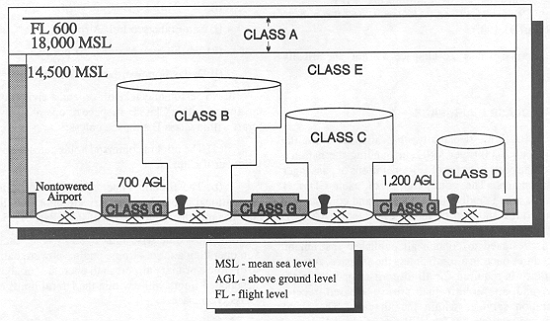
To start, the airspace over the United States is divided into four categories: Controlled, Uncontrolled, Special Use and Other airspace.
Controlled Airspace: Class A, B, C, D and E
There are five different classes of controlled airspace: A, B, C, D, and E airspace. A pilot requires clearance from ATC prior to entering Class A and B airspace, and two-way ATC communications are required before flying into Class C or D airspace.
- Class A airspace extends from 18,000 feet MSL to 60,000 feet MSL, or flight level 600. (Aviation fact: Altitudes above 18,000 are referred to as “flight level XXX” in hundreds of feet.)
- Class B airspace surrounds the busiest airports from the surface to 10,000 feet MSL. The dimensions of Class B airspace vary depending on the needs of the airport.
- Class C airspace extends from the surface to 4,000 feet MSL. These airports are busy enough to have an air traffic control tower and be serviced by radar approach control. The dimensions are tailored to each individual airport, but typically extend out to 5 miles for the inner layer and 10 miles for an outer layer that covers 1,200 feet to 4,000 feet (think of an upside down wedding cake.)
- Class D airspace surrounds smaller airports that have control towers and extends from the surface to 2,500 feet MSL.
- Class E airspace is controlled, such as airspace that surrounds instrument approach paths or federal airways, in all other locations other than Class A, B, C or D airspace, not including the uncontrolled Class G airspace.
Uncontrolled Airspace: Class G airspace (Aviation fact: There is no Class F airspace.)
Uncontrolled airspace is defined as any airspace that is not controlled airspace. There are almost no requirements for VFR aircraft flying in Class G airspace, other than certain cloud clearance and visibility requirements.
Special Use Airspace
Airspace reserved for specific uses, such as restricted areas, military operations areas and alert areas is designated as special use airspace. These areas each have their own requirements and limitations, depending on reason for the airspace. Some, like military operations areas, even have operating hours.
Other Airspace
Temporary flight restrictions (put in place when the President of the United States visits an area, for example) are an example of what the FAA classifies as “other” airspace. This category also includes military training routes, parachute jump areas, VFR routes and National Security Areas (NSAs).
Air Traffic Control
Air traffic control towers are found at all Class B, C and D airports, but the presence of an air traffic control tower does not mean that an airport is definitely located within Class B, C or D airspace.
The nation’s air traffic control system is a complex network of different types of controllers in different sectors that have different roles. This is also the reason that a single airport might have multiple control towers: one tower might be used for a particular sector of the airport while the other controls an opposing sector (or sometimes one is an old, outdated tower and one is new. That’s pretty common, too.)
Air traffic controller roles include ground control, approach, departure, terminal radar approach control (TRACON), and various others.