Private Pilot License: The First “Flight” in Your Pilot Training. Everything You Need to Know About the Private Pilot License and Where You Will Begin.
Do something you love and it will never feel like work. Many pilots choose aviation not just for a career, but also because of the passion they have for flying. Regardless if you are thinking about joining Phoenix East Aviation, or have just started looking at flight schools, let us explain where you will get started, the Private Pilot License. We are excited for you to continue strengthening the passion you have to fly and look forward to watching your dreams take flight!
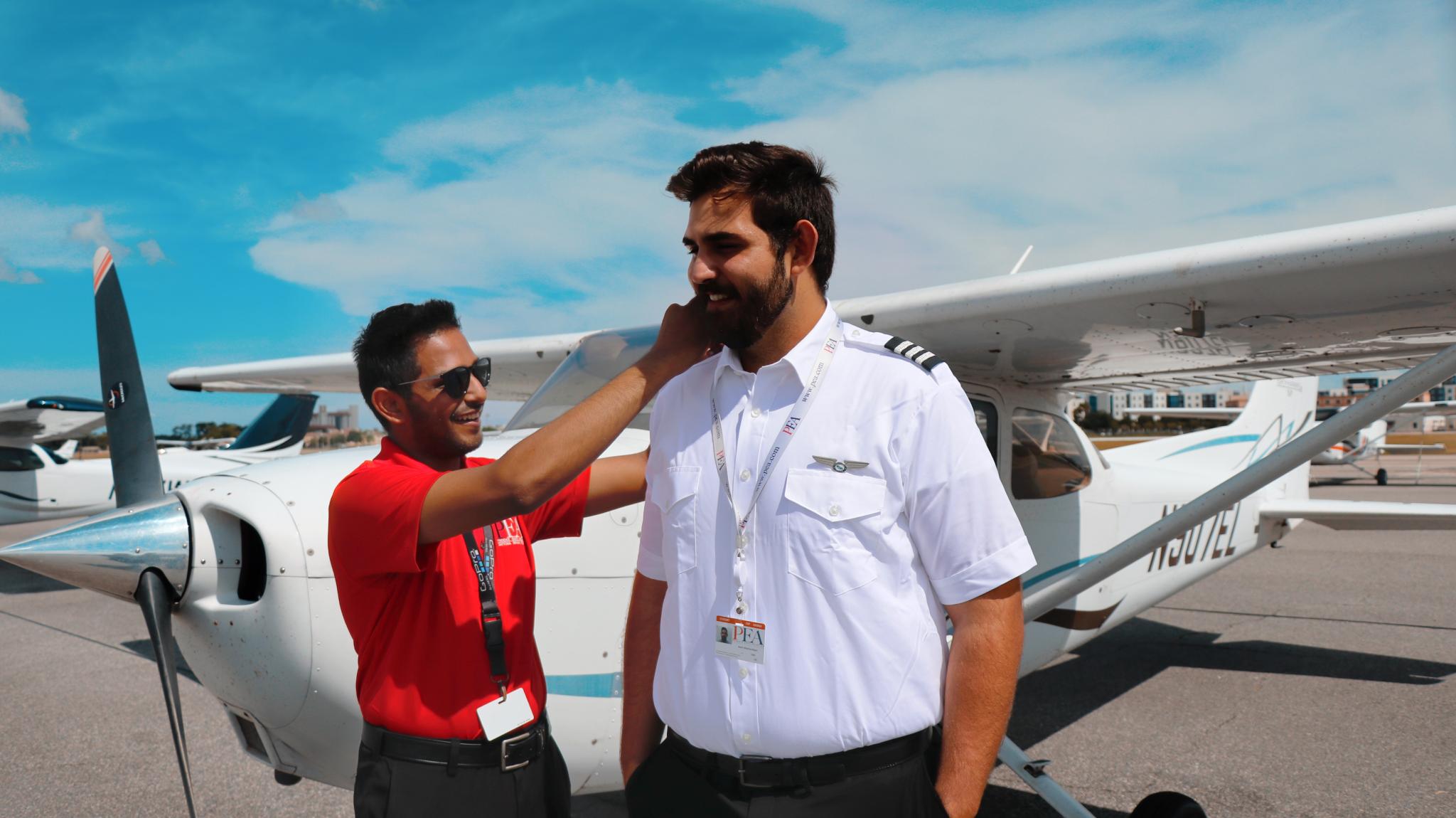
Druhv Patel, instructor on left giving PPL epaulettes to his student on the right
When people hear “private pilot”, they immediately think of private jets! However, the actuality is that a Private Pilot License is the initial license that a pilot earns, usually in a small single engine aircraft. Think of it this way, the best way to explain this starting block in your training, is it is your elementary education. You learn how to be a pilot in good weather conditions called VFR (visual flight rules). Thereafter is where you build on that knowledge by continuing your training by obtaining your Instrument rating, Commercial License, etc. Every pilot will begin with their Private Pilot License, regardless if they want to fly private jets or not!
The Private Pilot License is a type of pilot license that allows the holder to act as a pilot in command of an aircraft privately. As a private pilot, you have the privilege of flying an airplane during both day and night, as long as visibility is good. You can even bring passengers such as your family, friends, and coworkers on board. However, there are certain restrictions and limitations, such as not being allowed to fly for pay or hire. In other words, you cannot use your Private Pilot License to make money or look for jobs as a pilot. Nonetheless, you can share the operating expenses with your passengers. Obtaining a PPL is a fundamental step toward a fulfilling career as an airline pilot, where you can earn a good salary.
If you are interested in pursuing a Private Pilot License, there are certain requirements that you must meet. To start, you must be at least 16 years old to fly solo and at least 17 years old to receive your Private Pilot License. Additionally, you must be able to read, speak, write, and understand the English language, as this is the primary language used in aviation communication. You will also need to obtain at least a third-class medical certificate, which involves a physical exam that assesses your overall health and fitness to fly. Lastly, you must be able to perform basic math skills such as adding, subtracting, multiplying, and dividing, which are essential for aviation calculations.
The timeline of obtaining your Private Pilot License varies depending on the flight school selected and whether or not you choose to complete a Part 141 or Part 61 course. Phoenix East Aviation offers both. Assuming that you are starting with little to no experience, you can become a private pilot in 4 to 6 months.
Part 61 and Part 141 are two types of regulations that the Federal Aviation Administration (FAA) imposes on flight schools. Part 61 allows for more flexibility in scheduling and curriculum. As a student, you can adjust the training program to fit your needs and goals. In contrast, Part 141 has structured courses with predetermined schedules. The FAA requires flight schools to have an approved curriculum, certified instructors, lesson plans, and stage checks for students’ proficiency at each stage of training. Part 141 schools need fewer flight hours than Part 61, with a minimum of 35 hours to apply for a Private Pilot License (PPL). However, for the issuance of a Commercial Pilot License (CPL), Part 141 requires at least 120 flight hours, while Part 61 requires 250. Part 141 schools tend to cost less on paper when pursuing a commercial license, but the cost depends on the school’s reputation, state of aircraft, and even location. Phoenix East Aviation not only provides our students with a high standard of training, but also offers a 50 hour Commercial Pilot License Part 141 course. We have proved to the FAA we train at this high level of proficiency where we are able to provide our students with this unique opportunity. This helps cut down your timeline and cost!
One major concern you may have as a potential student, when beginning your training, is the cost. The aviation industry is expensive, however once you get through your training, it is highly lucrative. Pilot training is a financial commitment, but by being prepared and utilizing the resources available to you either online or in person, will allow you to set yourself up for success and ultimately save you time and money in the future. One unique opportunity that Phoenix East Aviation provides all of our students, is our free mentoring program. You are able to sign up for study or review sessions with approved mentors in any subject or topic you may find yourself struggling with.
If you plan on pursuing flight training, there are some important things to keep in mind. First and foremost, building a strong foundation is key. Additionally, at PEA we suggest the rule of 8’s, which entails getting 8 hours of sleep, 8 hours of work/study, and 8 hours for leisure and life outside of training. It is also important to learn from current mentors and instructors, as well as past students who have already gone through flight training. Finally, maintaining a positive outlook will help you stay motivated and focused throughout your training.
Everyone’s flight training journey is different. There is not one person’s path who looks identical to the next, and that is okay! What works for some, may not work for others, and vice versa. Don’t be afraid to ask questions because our admissions team is here to help you! We can assist you with reaching out to Alumni, current mentors, instructors, and even current students. Everyone at Phoenix East Aviation wants to see you succeed! Keep a positive outlook on your flight training. Yes, it can be challenging and at times it can seem overwhelming, but with a positive attitude and outlook on it, you are already on the right path to be successful! Always remember, positive thoughts equal positive results, and before you know it, you’ll be soaring through the skies!
Are you ready to watch your pilot dreams take off? Email us at info2@pea.com to get in touch with our esteemed admissions staff.
We wish you good luck in your studies!